

I’ll admit it: some of the things I do to prevent overeating sound almost ridiculous.
But they’ve helped me more times than I can count.
Not because they’re magic tricks or because they require incredible willpower. They simply make it easier for me to work with my brain instead of constantly fighting it.
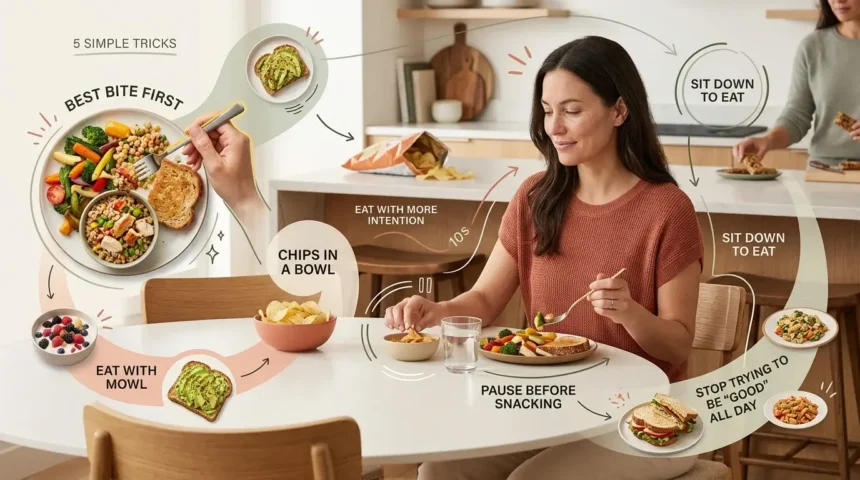
I Eat the Best Bite First
I used to save my favorite bite for the end of a meal. I thought it would make the meal more enjoyable.
Instead, I often spent the entire meal thinking about that last bite.
Now, I eat the most satisfying bite first. It helps me feel like I’m not missing out, which makes it easier to enjoy the rest of my meal without constantly chasing that “perfect” bite.
I Put Chips in a Bowl
I don’t believe chips are “bad” food.
But eating directly from a large bag makes it difficult for me to notice how much I’m actually eating. Putting them in a bowl gives me a clear portion and creates a natural stopping point.
The goal isn’t restriction. It’s simply making the amount I’m eating easier to see.
I Pause Before Grabbing a Snack
When I suddenly want a snack, I try to pause for about 10 seconds.
I take a breath and ask myself:
- Am I physically hungry?
- What am I feeling right now?
- What do I actually need?
Sometimes the answer really is food. Other times, I realize I need a break, some water, sleep, or simply a few minutes away from whatever I’m doing.
That tiny pause gives me a chance to choose instead of automatically reacting.
I Sit Down to Eat
Even when I’m having a quick snack, I try to sit down.
When I eat standing at the kitchen counter, I’m much more likely to eat without really noticing the experience. Sitting down creates a small boundary between “I’m grabbing something” and “I’m actually eating.”
That little change can make eating feel more intentional.
I Stop Trying to Be “Good” All Day
This one changed the way I think about overeating.
I used to try to eat as little as possible during the day so I could be “good.” By evening, I was usually thinking about food constantly and feeling much more likely to overeat.
When I started eating regular, satisfying meals throughout the day, I found that nighttime food cravings became much easier to manage.
For me, eating enough has been far more sustainable than constantly trying to eat less.
Small Changes Can Make Eating Feel Easier
None of these strategies is complicated, and none of them works perfectly every single time.
What they do is create a little space between an urge and my response.
I’ve learned that reducing overeating isn’t always about having more discipline. Sometimes it’s about changing my environment, paying attention to hunger and emotions, and making balanced eating easier.
And if overeating feels frequent, distressing, or difficult to control, I believe it’s worth talking with a qualified healthcare professional or registered dietitian rather than treating it as a simple lack-of-willpower problem.
Resources
- Harvard T.H. Chan School of Public Health — The Nutrition Source: Healthy Eating Plate
- National Institute of Diabetes and Digestive and Kidney Diseases (NIDDK) — information on healthy eating and weight management
- Academy of Nutrition and Dietetics — nutrition and mindful-eating resources

Riley Maloney is a Registered Dietitian Nutritionist (RDN) and Licensed Dietitian Nutritionist (LDN) with over 6 years of clinical experience helping individuals heal their relationship with food, recover from eating disorders, and improve their health without restrictive dieting. Practicing virtually from Chicago and contributing nutrition expertise to Doctiplus, Riley has supported over 800 clients on their journeys toward food freedom and body acceptance.